
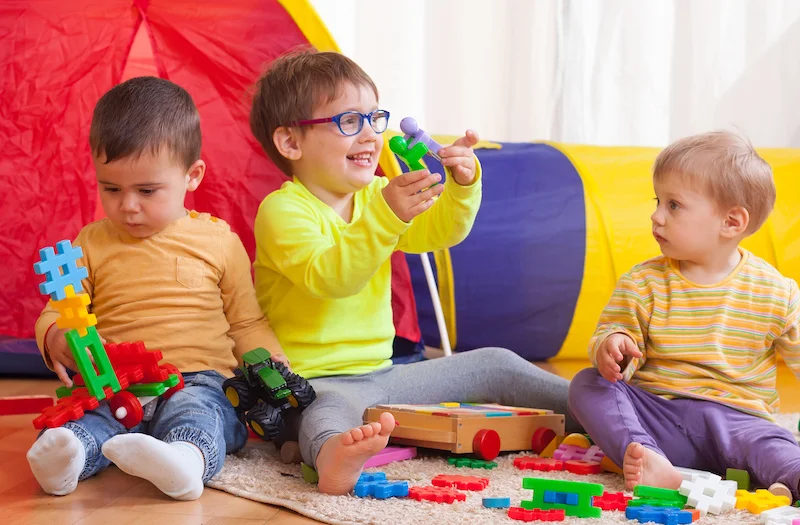
Play is more than just a fun way for children to pass the time – it is a key feature of a healthy childhood. It is an important part of learning and helps children grow socially, emotionally, and mentally. Children with an autism spectrum disorder (ASD) are not an exception. Play for all children can be both an inherently joyful experience and a powerful tool for building social skills and emotional regulation. By understanding how children play and how it helps them grow, we can use strategies to help make play meaningful for every child.
What is Play and Why Does It Matter?
Play means doing something because it’s fun or interesting, not because you earn a reward or someone told you to. Numerous studies with both children with and without ASD have shown that play benefits all children across multiple areas:
- Social Skills: Through play, children learn cooperation, turn-taking, perspective-taking, and empathy.
- Emotional Skills: Play supports self-regulation, emotional expression, and coping strategies.
- Cognitive Development: Play encourages problem-solving, creativity, imagination, and attention.
- Physical Development: Active play builds coordination, strength, and motor skills.
Taking advantage of the benefits associated with play can be especially helpful for children with an ASD diagnosis, as social skills, such as communication, are often areas targeted for improvement. Play offers a natural way to learn and practice these skills in an enjoyable, low-pressure environment.
Types of Play and Their Effects
Play comes in many forms, each helping children to learn and connect in different ways:
- Solitary Play: Independent play that helps kids think creatively, explore, and manage their emotions.
- Parallel Play: Playing next to other kids, without directly talking or engaging with each other, helping them watch and learn from their peers.
- Collaborative or Cooperative Play: Playing with other kids, working toward a shared goal, to build skills related to teamwork and communication.
- Imaginative or Symbolic Play: Pretend play, like acting out stories or pretending toys represent something they’re not, helping to build creativity and social understanding.
- Guided Play: Play supported by an adult or trusted peer to help the children learn social rules.
What Play Typically Looks Like in Children with an ASD Diagnosis
Children with ASD often engage in play differently than their neurotypical peers, particularly in unstructured environments such as playgrounds. Research has found that many children with ASD tend to show certain patterns in their play:
- Play in children with ASD often consists of repetitive actions or a focus on certain materials, such as toys or sensory objects. These types of repetitive actions or material fixation are not always the case and will look different for each child.
- Children with ASD often show difficulties playing with other kids. This can show up as difficulties in initiating or joining games involving peers, responding to social cues during play, or figuring out how to join pretend or group play.
- Often, children with ASD indicate they prefer playing beside other kids (parallel play) but not directly with them.
- Children with ASD show increased levels of engagement in play when the activities or games match their interests, consistent with both solitary and collaborative play.
- Overall, solitary play can be particularly beneficial for children with ASD, as it can help with emotional regulation while also promoting creative exploration.
How Can We Support Play?
Structured play approaches can help support children with ASD build social and play skills. Two widely studied models are the Integrated Play Group model, designed to help children learn social and play skills through small groups of peers, and the Floor Time model, which focuses on developing skills related to building relationships, such as expressing emotions. Let’s take a closer look at how each works and your role in helping support play with each model.
The Integrated Play Group Model
The theory: Children learn best through social interaction.
The goal: Use play – taking turns, starting interactions, co-operating, taking the perspectives of others – to improve social and symbolic skills
How it works: The IPG consists of guides, expert players, and novice players. Guides are adults who typically have experience and training in working with children with ASD. Expert players are socially competent peers, and novice players are children with ASD. Ideally, the IPG will consist of a guide and 3-5 children, with a higher ratio of expert than novice players. Initially, the guide will play a more active role, directing the play and assisting the novice players (using their favourite activities and strengths). As the children develop skills and become more capable, the guide takes a more passive role, slowly reducing support until it is no longer needed.
Your role: Support the child’s initiations of play through guided participation and by arranging the physical environment to encourage the child’s preferred type of play.
Tips: Research suggests constructive and sociodramatic toys are the most effective for social development, for example, building blocks (such as Lego) and role-playing toys (like puppets and dolls). For optimal results, use a scheduled routine for this type of guided play, ideally two to three times a week for 30 to 60 minutes. Visual cues to assist with the ease of transition in and out of play are recommended.
The Floor Time Model
The floor-time model has been shown to improve children’s ability to effectively share their emotions with others (in particular, pleasure) and respond appropriately during play.
The theory: Through repeated emotional interactions, children grow cognitively and emotionally.
The goal: Overall, the floor time model encourages flexibility and reciprocity, while also building social communication skills.
How it works/Your role: Play in the floor time model is directed by the child and supported by an adult. It involves five key steps.
- Observe the child engaging in their chosen play activity, with a focus on figuring out the best way to approach the child.
- Approach the child, mirror their emotional tone, and try to join the child in their chosen activity.
- Allow the child to direct the action of the play, follow their lead.
- Expand on the child’s directions for play – focus on not being intrusive.
- When the child responds to you, they’re keeping the playful interaction going. (For example, if a child is focused on lining up blocks, you can join by adding to the line, then subtly change its direction. When the child continues the new pattern, they close the circle of communication.)
Additional Tips and Strategies to Support Play
You can try the following to maximize the effectiveness of the above intervention models:
- Offer choices: let the child choose the activities and materials that are of interest to them. This will increase their motivation to initiate and persist in play.
- Keep it familiar: provide materials that are both engaging and familiar to the child to support their comfort level in the play environment.
- Be a strong model: demonstrate appropriate behaviours for social interactions such as sharing and turn-taking, gradually reducing the levels of modelling/support as the child progresses.
- Support peer play: create structured opportunities with socially strong peers to help practice learned skills.
- Include solo play: both collaborative and solitary play have positive impacts on development; create opportunities for both.
- Create inclusive environments: ensure the play space is welcoming for all children, with tailored support to the unique needs of each child. If a child feels as if their presence is not desired, they will be less likely to attempt to initiate play.
- Use technology thoughtfully: digital and virtual tools can often provide opportunities for collaborative play that may be more comfortable for children with ASD. However, use technological tools carefully and thoughtfully, ideally as a way to introduce children to cooperative play, and then gradually transition to face-to-face interactions.
- Watch and adjust: observe how the child is progressing through the intervention and adapt accordingly. Tailor the play to the child’s unique strengths, interests, and current social skills.
Takeaway
Play is a vital part of childhood, having a key role in social, emotional, and cognitive development. In particular, for children with ASD, play can provide opportunities to strengthen social communication, collaborative skills, and problem-solving abilities. For children who have difficulties with social and emotional regulation, structured opportunities for play can be a great way to practice social and emotional skills. To do this well, it helps to understand the child’s unique play preferences and their pre-existing strengths. Using these approaches to play can help children with ASD thrive both on the playground and beyond. Creating inclusive and enjoyable play experiences for all children is not only essential for development but also a celebration of childhood itself.
References:
Autism Speaks. (2025). Autism and Social Skills Development. https://www.autismspeaks.org/tool-kit-excerpt/autism-and-social-skills-development
Bennie, M. (2023). Supporting Autistic Children through Structured Play – Autism Awareness. Autism Awareness. https://autismawarenesscentre.com/supporting-autistic-children-through-structured-play/
Lantz, J. (2001). Play Time: An Examination of Play Intervention Strategies for Children with Autism Spectrum Disorders. Indiana Resource Center for Autism. https://iidc.indiana.edu/irca/articles/play-time-an-examination-of-play-intervention-strategies-for-children-with-autism-spectrum-disorders.html
Khatab, S., Hijab, M. H. F., Othman, A., & Al-Thani, D. (2024). Collaborative play for autistic children: A systematic literature review. Entertainment Computing, 50, 100653. https://doi.org/10.1016/j.entcom.2024.100653
Kids First. (2025). The Importance of Social Play for Children with Autism – Kids First. https://www.kidsfirstservices.com/first-insights/the-importance-of-social-play-for-children-with-autism
Mastermind Behavior. (2025). How to Create Social Opportunities for Children with Autism in the Community. https://www.mastermindbehavior.com/post/how-to-create-social-opportunities-for-children-with-autism-in-the-community
O’Keeffe, C., & McNally, S. (2025). ‘Like it’s making my heart run’: A strengths-based understanding of the play of autistic children. Autism. https://doi.org/10.1177/13623613251315985