Conflict in the Workplace and Burnout
Tatina Phan, M.S.W., RSW
Understanding and Managing Grief
Marion Hurd, M.S.W., RSW
WELCOME TO OUR SPRING 2023 NEWSLETTER
Finally, Spring has arrived and soon we will be able to complain about the heat. But in the meantime, let’s enjoy the glorious weather and Spring flowers. In this Newsletter we have an article by Tatina Phan on “Conflict in the Workplace and Burnout” something very apparent through the dark COVID times, when organizations were understaffed and overloaded.
Hopefully we are over the worst of those times but if you still are experiencing burnout we are here to help. Marion has some practical advice for you in managing your own grief or helping someone else during the grieving process.
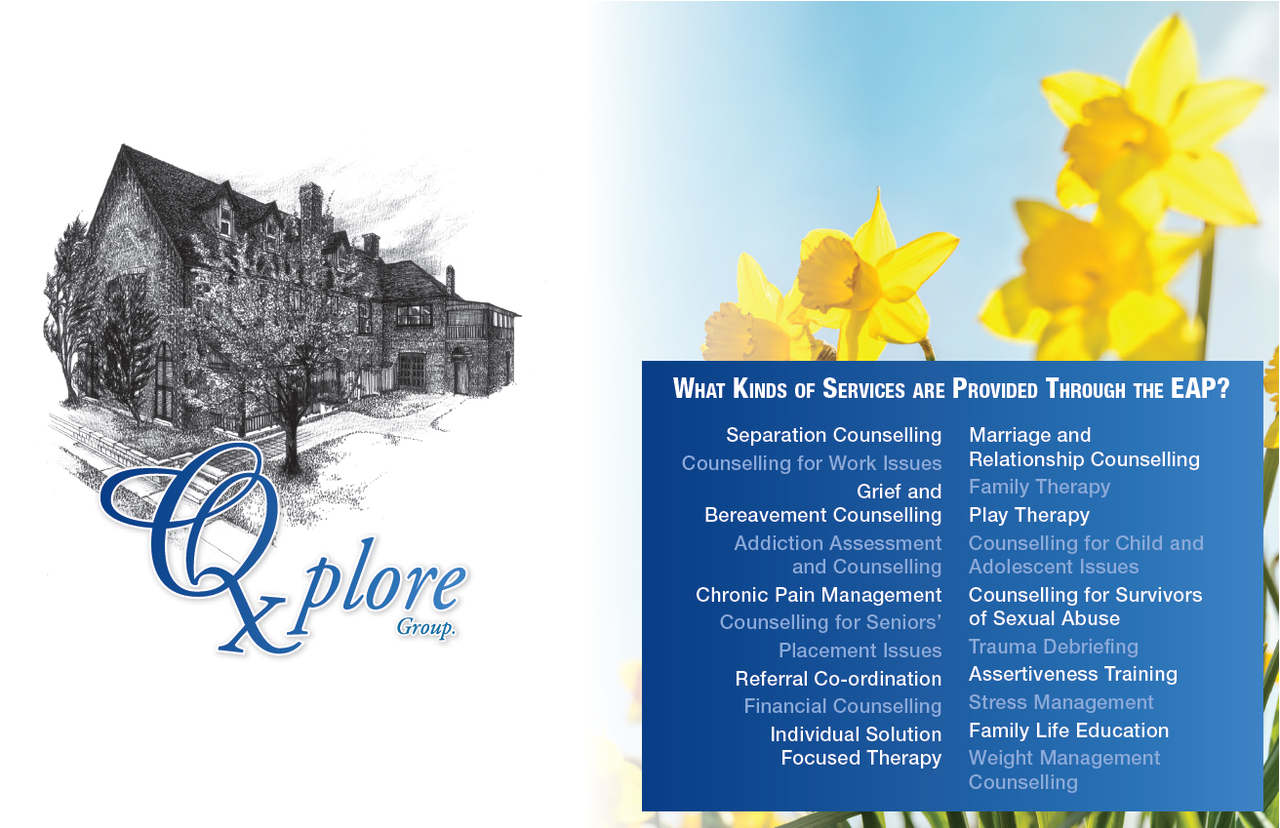
If you or a family member are experiencing personal issues then your EAP can help you with address and manage conflict, burnout, grief, stress, anxiety, financial issues, and relationship difficulties. We provide services both in person and virtually, whichever you prefer, just give our Reception a call.
CONFLICT IN THE WORKPLACE AND BURNOUT
Tatina Phan, M.S.W., RSW

Studies have shown that conflict experienced in the workplace can cause significant stress on an employee’s mental health, and can even lead to burnout. Workplace conflicts can come about for many reasons such as work overload, bullying, personality differences, perceived unfair treatment, lack of support, communication issues and misunderstandings, as well physical and verbal aggression by clients or patients.
Burnout is a phrase that is often used to describe high stress and general dissatisfaction in the workplace, however there are conditions that are collectively specific to burnout that are different from stress or depression. In general, burnout is often talked about in relation to job
duties and responsibilities but what is not often talked about is how the relationships at work can also lead to burnout such as unpleasant exchanges with coworkers and clients as well as a negative workplace environment (Wright et al., 2014, p. 515).
What is burnout?
Burnout is a serious effect of prolonged exposure to difficult and demanding work situations and is defined as a psychological response to chronic work stress (Smith et al., 2019, p. 215). When you are experiencing burnout, it is often difficult to see the value of the work you do and you can start to doubt your ability to do your job.
QUINTE COUNSELLING SERVICES INC.

Burnout includes three dimensions: (1) emotional exhaustion, (2) depersonalization, and (3) reduced feelings of personal accomplishment (Vincent-Hoper et al. 2020, p. 2).
Emotional exhaustion is feeling stretched thin with no more mental, emotional, and physical resources to give your job.
Depersonalization or sometimes referred to as disengagement, is the tendency to have a pessimistic or cynical attitude about your work environment and in turn responding in a detached way towards your work and anyone who you interact with at work. This is seen as a coping reaction to emotional exhaustion because it essentially creates a mental and emotional distance between yourself and your job (Reichl et al., 2014, p. 982).
Reduced feeling of personal accomplishment is the tendency to judge yourself negatively and be dissatisfied with the job as well as your own performance in the job.
Talking about burnout is important on many levels because its effects negatively impact your mental health, your work performance, and your personal life. If you are feeling exhausted, depersonalized, and unhappy with your work, you will in turn feel angry, dissatisfied, frustrated in life and experience conflict in your family and your immediate environment (Danauske et al., 2023, p. 60).
Through individual therapy sessions, I can support employees who are experiencing high stress and/or burnout at work and at home in order to increase your quality of life and seek clarity in a safe setting.
References
Danauske, E., Raisiene, A. G., & Korsakiene, R. (2023). Coping with burnout? Measuring the links between workplace conflicts, work-related stress, and burnout. Business: Theory and Practice 24(1), 58-69.
Reichl, C., Leiter, M. P., & Spinath, F. M. (2014). Work-nonwork conflict and burnout: A meta-analysis. Human Relations 67(8), 979-1005.
Smith, T. D., DeJoy, D. M., Dyal, M., & Huang, G. (2019). Impact of work pressure, work stress and work-family conflict on firefighter burnout. Archives of Environmental & Occupational Health 74(4), 215-222.
Vincent-Hoper, S., Stein, M., Neinhaus, A., & Schablon, A. (2020). Workplace aggression and burnout in nursing: The moderating role of follow-up counseling. International Journal of Environmental Research and Public Health 17(3152), 1-12.
Wright, K. B., Abendschein, B., Wombacher, K., O’Connor, M., Hoffman, M., Dempsey, M., Krull, C., Dewes, A., & Shelton, A. (2014).
Work-related communication technology use outside of regular work hours and work life conflict: The influence of communication technologies on perceived work life conflict, burnout, job satisfaction, and turnover intentions. Management Communication Quarterly 28(4), 507-530.
Tatina Phan, M.S.W., RSW is a Registered Social Worker with over 10 years experience working with children and families. Her areas of clinical practice include trauma, grief and loss, resilience, compassion fatigue and burnout, crisis intervention, healing from abuse and adverse childhood experiences, and overall mental wellness. Tatina provides psychotherapy services through the EAP, WSIB and privately.
Did you know…
→Appointments are scheduled at a time that is convenient for you and usually within two to three days?
→No one at your place of employment will know that you have used your EAP unless you tell them?
→Counselling is provided for a broad range of services, including marital and relationship; parenting; stress; separation/divorce trauma; workplace; and personal issues?
→Counsellors can help you access community resources and support groups?
→A comprehensive description of the services provided through your EAP is available through your EAP brochure or on our website at www.qxplore.com?
Understanding and Managing Grief
Marion Hurd, M.S.W., RSW
A person who has experienced the death of someone they love may feel as if they have been ripped apart by their grief. One meaning of the root word “reave” in “bereavement” is the literal tearing away or the taking of something by force. The person who is grieving is suddenly thrust into an unknown and unwelcome situation, bewildered and shaken by intense emotions and a deep sense of loss.
Theories of mourning, such as the five stages model proposed by Dr. Elisabeth Kübler-Ross (Kübler-Ross E., Kessler D., 2005). assume that there is a standard progression of emotions through stages during the grieving process. For some mourners it can be comforting to think of an objective and defined process for their sorrow. It may also be helpful to acknowledge that strong emotions such as anger may be experienced after the death of a loved one. However, assuming that grief can be compartmentalized and endured in such a defined manner doesn’t truly do service to the depth of the emotional pain that people experience during mourning.
Also, the language that is used to comfort those who are grieving – while meant to be helpful – can sound very judgmental and harsh. Phrases like, “you will get over it” or “be strong” imply that there is something wrong with the person who is in mourning. Well meaning friends and family may
QUINTE COUNSELLING SERVICES INC.
suggest that grief can be “fixed” or that it is possible to “just get on with it” during a defined period. In fact, the trajectory of grief is highly personal and subjective. Someone who is grieving may experience both physical and emotional suffering and grief may not resolve quickly.
The Diagnostic and Statistical Manual of Mental Disorders, Fifth Edition (DSM-5) describes complicated or prolonged grief as being, in general: intense and persistent, delayed or even absent, for example when a person shows few or no visible signs of the loss. (APA, 2022). This is based on research into the grieving process which indicates that most people experience its peak within 6 months. Complicated grief which lasts beyond one year is characterized in part by: deep emotional pain or, at the other extreme, numbness to pain, avoidance of reminders of the loss, having difficulty with resuming regular routines and disbelief about the death. Individuals experiencing complicated grief may also suffer from mood and sleep disorders. (The Centre for Prolonged Grief, 2023). It is very important to seek professional counselling if you believe that you are struggling with complicated grief.
Wherever you are in the process of grief it is helpful is to understand that dealing with the sorrow of loss requires courage. The root of the word “courage” is “coeur”, French for heart, and the healing of a broken heart requires time, patience – and courage. Everyone experiences grief differently but there are strategies that may provide practical supports for self-care – not all solutions will appeal to everyone, but these may be helpful:
- Try to maintain social contacts for support and to combat loneliness and avoid isolation. It may be difficult to ask for help when you are struggling but friends and family usually welcome the chance to provide loving support.
- Don’t expect that you will be able to carry on as you did before. You may need to nap more often or go to bed earlier. Practice whatever type of self care provides you with the most comfort. And if you need to cry, you should cry.
- Understand that you may experience physical symptoms. Your appetite or sleep patterns may be affected. Grieving is hard work, and you have to be gentle with yourself and perhaps lower expectations of what you will be able to accomplish.
- If you long to be pampered, then find an activity or an experience that will give you pleasure
- Keep a journal for yourself or perhaps write a letter to the person who has died. Writing down feelings or emotions or communicating your love and sense of loss in writing can provide relief.
- Maintaining good eating habits and getting enough sleep and exercise are vital to good physical heath. Consult your doctor for any issues that you may be having with your general health.
- Perhaps rekindle an interest in an activity that used to give you pleasure – art, crafting, photography, gardening – whatever sparks your interest and creates happiness.
- Seek grief counselling especially if you feel a sense of hopelessness or are at risk of self harm.
If you are supporting someone during the process of grieving here are some suggestions that may be useful:
- Offering practical help is always welcome – bringing food or running errands can give the person who is grieving some personal space when they may not be able to articulate what they need. It also provides a concrete example of how much you care.
- Don’t be hesitant about reaching out to provide emotional support. It is easier to avoid difficult conversations by believing that “She will contact me if she needs me.” But calling and asking a simple question such as, “How are you feeling today?” opens the door to providing compassionate encouragement. It also acknowledges that not every day is a good day and allows the mourner to say as much or as little as they are comfortable with expressing.
- Just listen – being present and empathetic during a difficult conversation is a gift to the person because it allows them to communicate their grief. Also remember that silence can give the mourner space to express their deep feelings of loss. Human beings need to tell stories in order to make sense of experiences beyond their control. Being a compassionate witness – having an open mind and heart – is key to supporting someone who is grieving.
References:
-
- American Psychiatric Organization, (2022, May) Prolonged Grief Disorder
- The Centre for Prolonged Grief, Defining Grief. Retrieved April 9, 2023 from Prolongedgrief.columbia.edu
- Kübler-Ross E., Kessler D. (2005). On grief and grieving: Finding the meaning of grief through the five stages of loss. New York, NY: Scribner.3
Marion Hurd, M.S.W., RSW is a Registered Social Worker who provides services through EAP programs and privately. Marion’s areas of strength include counselling to address depression, work-life balance, anxiety and grief.

QUINTE COUNSELLING SERVICES INC.